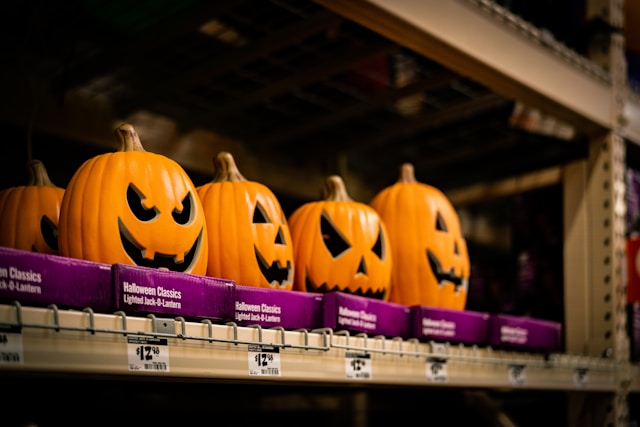
My boyfriend and I ran into Walgreens this weekend to pick up a couple of things. As we walked in, he stopped dead in his tracks and pointed to the Halloween displays that were up in this first week of August. What the heck?
I got super annoyed. It’s too early. It’s the middle of summer. I am thinking about picnics and going to the beach. I don’t want to think about the end of October when it gets dark at 4:00 PM. I don’t want to think about what I feel is the worst holiday of the year. (I know other people love it, but I just don’t. I didn’t even like it as a kid.)
Seeing these displays in August makes me want to boycott and not buy any Halloween stuff this year, which is exactly what I did last year.
One marketing strategy is to confine sales to a certain period, assuming that people will act during the fixed window of time, instead of putting it off if those products are available all the time. This weekend, I found myself wondering if putting up Halloween displays ridiculously early, instead of waiting until after October 1 or Labor Day, which would make more sense, actually boosts sales.
As it turns out, Halloween retail sales numbers in the United States have shown significant growth over the past decade, nearly doubling since 2014.
I don’t remember displays going up so early in the past, so maybe the strategy is working? That is kind of depressing.
According to this article, “The projected expenditure for Halloween costumes and decorations is $3.8 billion each in 2024. Moreover, Americans will spend a whopping $3.5 billion on trick-or-treat candy.” Also from the article, “Stats indicate that the number of shoppers buying Halloween items online before October 1 is rising.”
As it turned out, sales in 2024 were down slightly from 2023, which was the all-time high. Ecommerce is getting a lot of the business, with Amazon leading the pack, not surprisingly.
What do people plan to buy for Halloween? These statistics from the National Retail Federation from September 2024 were fascinating:
Like previous years, the top ways consumers are planning to celebrate are handing out candy (68%), decorating their home or yard (53%) or dressing in costume (50%). However, in a return to pre-pandemic norms, more consumers also plan to throw or attend a party (32%) or take their children trick-or-treating (28%).
Per person spending is also up as consumers plan to spend a record $108.24 each, up from the previous record of $102.74 in 2021. The greatest increase in spending came from costumes, which are more popular than ever.
I guess we are stuck with Halloween displays in August and Christmas displays for half the year from July on. Retailers are going to continue doing this if it is working, which it seems to be.
Photo by Oxana Melis on Unsplash